Client
A Global Logistics Company
Reducing Cross-Border Payment Costs by <1% for a Global Logistics Company
A global logistics company reduced cross-border payment costs to under 1% by launching a stablecoin-powered payment solution for its SME clients.

Overview
A global logistics company reduced cross-border payment costs to under 1% by launching a stablecoin-powered payment solution for its SME clients.
Industry Context
Stablecoins are not merely crypto-native tools.
They are becoming an alternative global settlement layer.
For SME clients in emerging markets, international payments are often:
Slow (2–5 business days)
Expensive (3–7% total effective cost including FX spreads and intermediary fees)
Operationally complex (multiple banking counterparties, reconciliation friction)
At the same time, global stablecoin adoption has introduced a new settlement layer:
24/7 programmable transfers
Near-instant settlement
Transparent ledger visibility
Significantly reduced intermediary costs
However, most Web2 enterprises lack the regulatory, product, and infrastructure capabilities to translate this into a production-grade solution.

The Aspiration
The client sought to:
Reduce cross-border payment costs for SME customers
Accelerate settlement cycles across key trade corridors
Unlock new payment routes in regions underserved by correspondent banking
Gain better transaction visibility to enable cross-selling and embedded finance
Modernize infrastructure without disrupting core logistics operations
This was not a crypto experiment.
It was an operating model transformation.
Impact
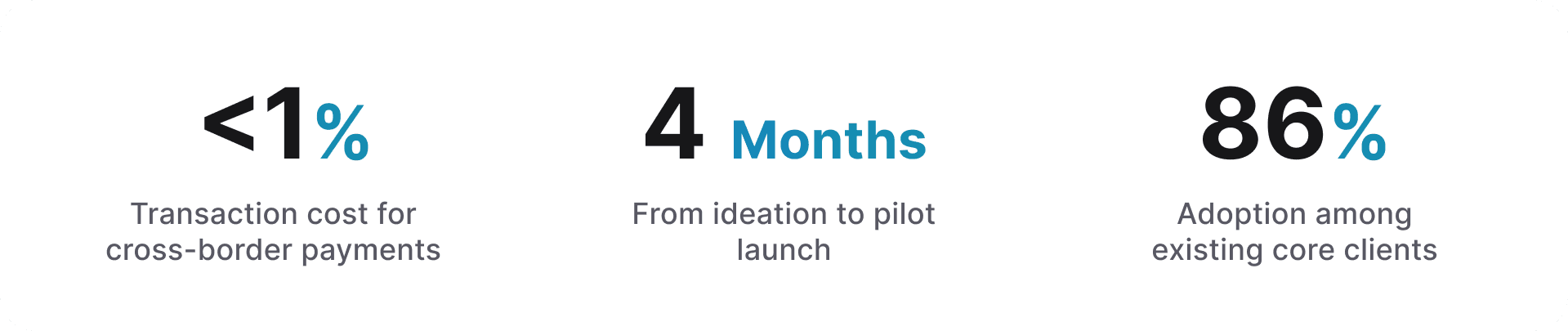
The solution combined clear use-case definition with a production-ready operating model, enabling rapid deployment across multiple corridors. By aligning product design, regulatory considerations, and ecosystem partnerships early, the company delivered measurable cost savings while strengthening customer engagement and expanding service offerings.
Strategic Mandate & Execution
We worked alongside the client from strategic validation to pilot launch, translating stablecoin infrastructure into an enterprise-grade payment system.
Our intervention spanned three integrated phases.
1. Strategy & Business Case Design
We began with structural validation:
Assessed payment volume flows across corridors
Modeled cost differentials vs. traditional correspondent banking
Quantified FX spread leakage and settlement delays
Identified corridor prioritization based on regulatory feasibility
We defined the target operating model:
Stablecoin as settlement rail, not speculative asset
Hybrid on/off-ramp design
Treasury management framework
Compliance architecture aligned with UAE and corridor jurisdictions
2. Product Architecture & Operating Blueprint
We designed a production-ready operating structure:
End-to-end payment workflow mapping
Stablecoin custody and treasury flows
Counterparty risk controls
Corridor-based liquidity provisioning strategy
Partner identification (custody, exchanges, liquidity providers)
We structured:
On-chain settlement mechanics
Fiat conversion layers
Reconciliation logic integrated into existing ERP systems
Governance and internal control frameworks
3. Launch Execution & Corridor Deployment
We led the pilot deployment:
Prioritized high-friction trade corridors
Structured phased rollout
Activated ecosystem partnerships
Designed client onboarding strategy
Built monitoring dashboards for cost and settlement performance
Related Capabilities
Web3 & Digital Asset Strategy
Stablecoin Design & Treasury Structuring
Product Launch & Go-To-Market
Interested in similar results for your organization?
Find out more.


Schedule a Strategy Session
Available virtually worldwide or in person at our New York headquarters.

New York Headquarters
340 Madison Ave, New York, NY








Schedule a Strategy Session
Available virtually worldwide or in person at our New York headquarters.
New York Headquarters
340 Madison Ave, New York, NY
Schedule a Strategy Session
Available virtually worldwide or in person at our New York headquarters.
New York Headquarters
340 Madison Ave, New York, NY